AOD-9604
A modified growth-hormone fragment studied for lipolytic and fat-metabolism pathways.
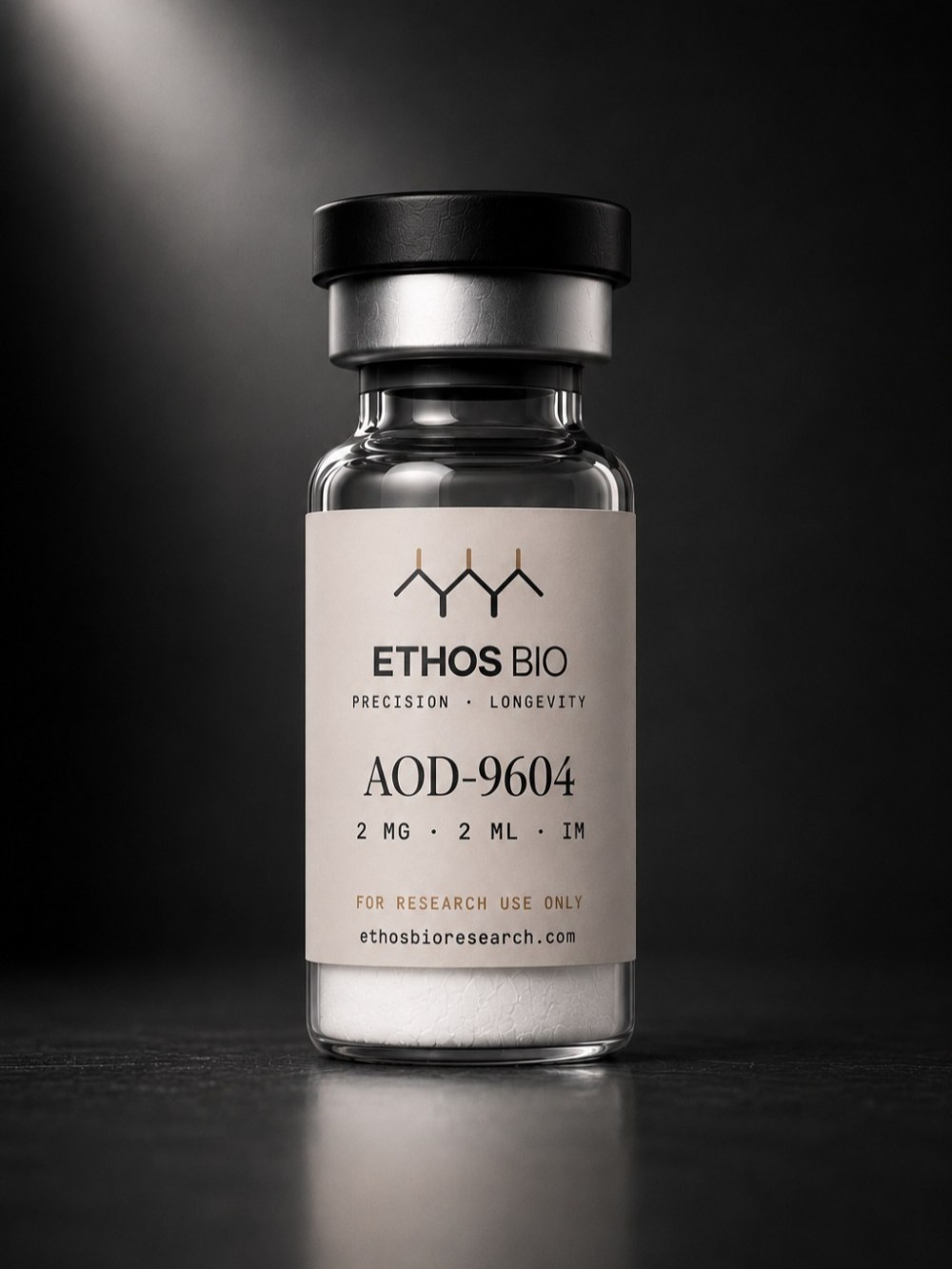
01At a Glance
| Compound | AOD-9604 (AOD9604) |
| Classification | Metabolic research compound |
| Molecular weight | 1,815.1 g/mol |
| Sequence / Form | Modified hGH(176-191) fragment |
| Purity | ≥99% HPLC, identity verified by mass spectrometry |
| Documentation | Batch-specific Certificate of Analysis available |
| Appearance | White lyophilized powder |
| Storage | Store sealed at 2–8°C. Long-term storage per certificate guidance. |
| Use | Research Use Only. Not for human or veterinary use. |
02Mechanism of Action
AOD-9604 is a synthetic modified fragment of human growth hormone corresponding to the C-terminal residues 176-191 with a tyrosine modification. Research focuses on its lipolytic activity and effects on fat metabolism.
A distinguishing research property is that it is studied for metabolic effects without IGF-1 receptor activation or the growth-promoting effects of full-length hGH.
Research framing only · No human-use claims
03Research Context
- Lipolysis and fat-metabolism assays
- Adipocyte metabolic-pathway research
- Body-composition model studies
- hGH-fragment comparative research
04Quality & Verification
Ethos Bio presents compound information with an emphasis on identity verification, purity analysis, certificate access, and storage guidance. Product-specific documentation is available through the certificate page where applicable. Cold-chain shipping is available where required, and inventory is held under refrigerated conditions at our fulfillment center with temperature-logging protocols in place.
05FAQ
What is AOD-9604?
AOD-9604 is a modified hGH(176-191) fragment studied for lipolytic and fat-metabolism pathways in research models, without IGF-1 activation. It is a research-use-only compound.
Does AOD-9604 affect IGF-1?
In research models AOD-9604 is studied for fat-metabolism effects without IGF-1 receptor activation, distinguishing it from full-length growth hormone.
What is AOD-9604\u2019s molecular weight?
AOD-9604 has an approximate molecular weight of 1,815.1 g/mol and CAS number 221231-10-3.
How should AOD-9604 be stored?
AOD-9604 ships lyophilized and should be handled per standard research-peptide practice — kept cold, protected from light and moisture, and reconstituted only for laboratory use. Cold-chain handling is used where required. For research use only.
Is AOD-9604 approved for human use?
No. AOD-9604 is sold strictly for laboratory research use only and is not a drug or supplement. It is not approved for human or veterinary use or consumption.
How is AOD-9604 tested at Ethos Bio?
Every AOD-9604 lot is independently verified by MZ Biolabs, a third-party analytical laboratory in Arizona, on a five-point panel — RP-HPLC purity, HPLC-MS identity, endotoxin (LAL), heavy metals, and sterility. A lot-specific certificate of analysis ships with the vial. See How We Test for the full methodology.