BPC-157
A synthetic gastric pentadecapeptide widely studied for angiogenic and cytoprotective signaling.
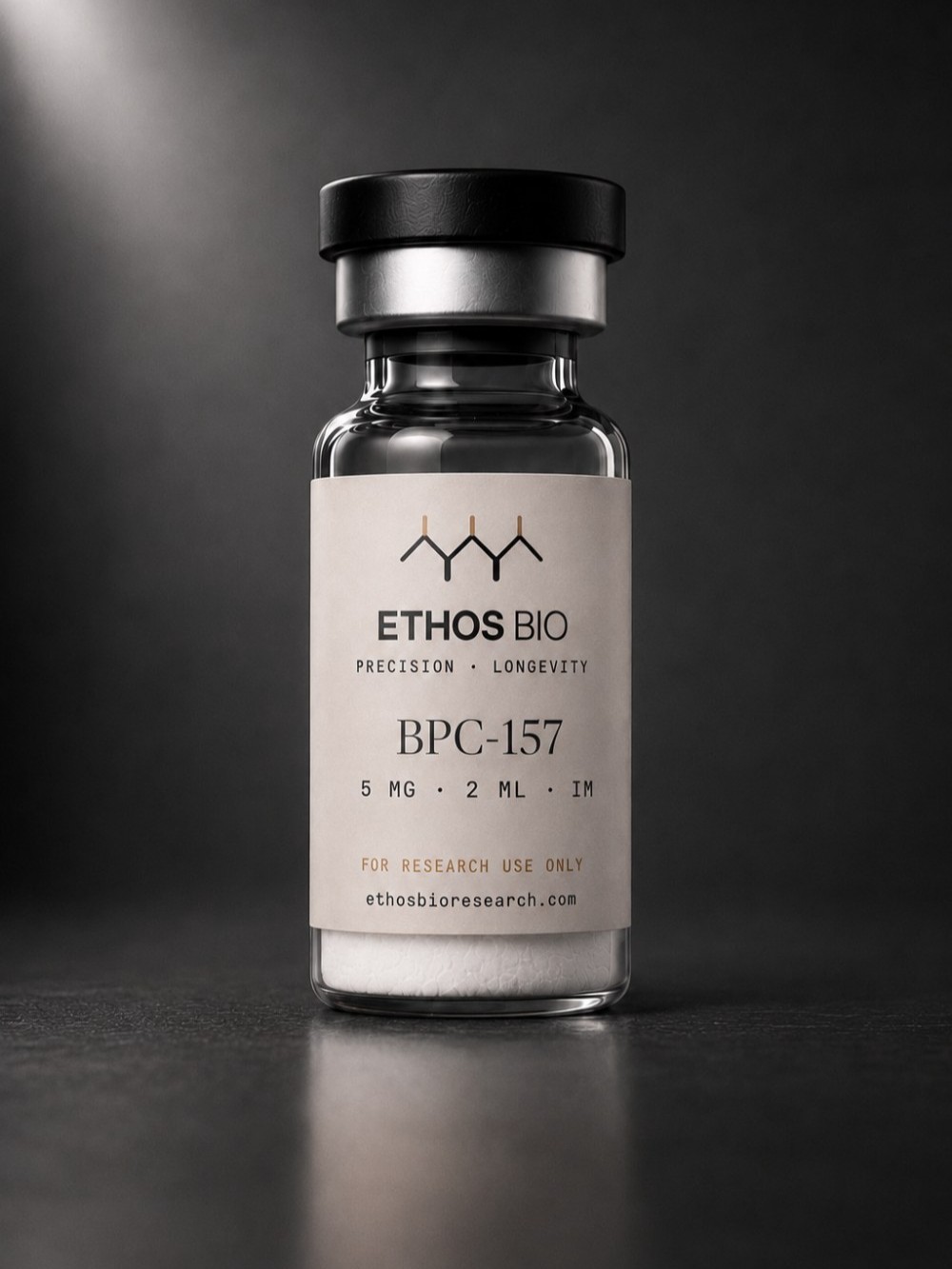
01At a Glance
| Compound | BPC-157 (Body Protection Compound 157; PL 14736) |
| Classification | Regenerative research compound |
| Molecular weight | 1,419.5 g/mol |
| Sequence / Form | Gly-Glu-Pro-Pro-Pro-Gly-Lys-Pro-Ala-Asp-Asp-Ala-Gly-Leu-Val |
| Purity | ≥99% HPLC, identity verified by mass spectrometry |
| Documentation | Batch-specific Certificate of Analysis available |
| Appearance | White lyophilized powder |
| Storage | Store sealed at 2–8°C. Long-term storage per certificate guidance. |
| Use | Research Use Only. Not for human or veterinary use. |
02Mechanism of Action
BPC-157 is a stable 15-amino-acid sequence derived from a protective protein found in human gastric juice. In research models it is most associated with the VEGFR2–Akt–eNOS signaling axis, where it has been reported to upregulate vascular endothelial growth factor receptor 2 and promote angiogenesis in endothelial cell assays.
Additional published work examines its interaction with the nitric oxide (NO) system and the FAK–paxillin pathway governing fibroblast and tendon-cell migration, as well as modulation of growth-factor expression. These pathways are the focus of in-vitro and animal-model investigation only.
Research framing only · No human-use claims
03Research Context
- Angiogenesis and endothelial tube-formation assays (VEGFR2 signaling)
- Tendon-, ligament-, and fibroblast-migration models
- Gastrointestinal epithelial and mucosal-integrity research
- Nitric-oxide pathway and vascular-tone studies
04Quality & Verification
Ethos Bio presents compound information with an emphasis on identity verification, purity analysis, certificate access, and storage guidance. Product-specific documentation is available through the certificate page where applicable. Cold-chain shipping is available where required, and inventory is held under refrigerated conditions at our fulfillment center with temperature-logging protocols in place.
05FAQ
What is BPC-157 in research terms?
BPC-157 is a synthetic 15-amino-acid peptide derived from a sequence in human gastric protein. It is studied in vitro and in animal models for angiogenic (VEGFR2) and cell-migration signaling. It is sold for research use only and is not for human consumption.
What is the molecular weight and CAS number of BPC-157?
BPC-157 has a molecular weight of approximately 1,419.5 g/mol and CAS number 137525-51-0.
How is BPC-157 purity verified?
Each Ethos Bio lot is analyzed by reverse-phase HPLC and independently confirmed by mass spectrometry, with a certificate of analysis documenting ≥99% purity provided per lot.
How should BPC-157 be stored?
BPC-157 ships lyophilized and should be handled per standard research-peptide practice — kept cold, protected from light and moisture, and reconstituted only for laboratory use. Cold-chain handling is used where required. For research use only.
Is BPC-157 approved for human use?
No. BPC-157 is sold strictly for laboratory research use only and is not a drug or supplement. It is not approved for human or veterinary use or consumption.
How is BPC-157 tested at Ethos Bio?
Every BPC-157 lot is independently verified by MZ Biolabs, a third-party analytical laboratory in Arizona, on a five-point panel — RP-HPLC purity, HPLC-MS identity, endotoxin (LAL), heavy metals, and sterility. A lot-specific certificate of analysis ships with the vial. See How We Test for the full methodology.