Cagrilintide
A long-acting amylin analog studied for amylin-receptor signaling and satiety-pathway research.
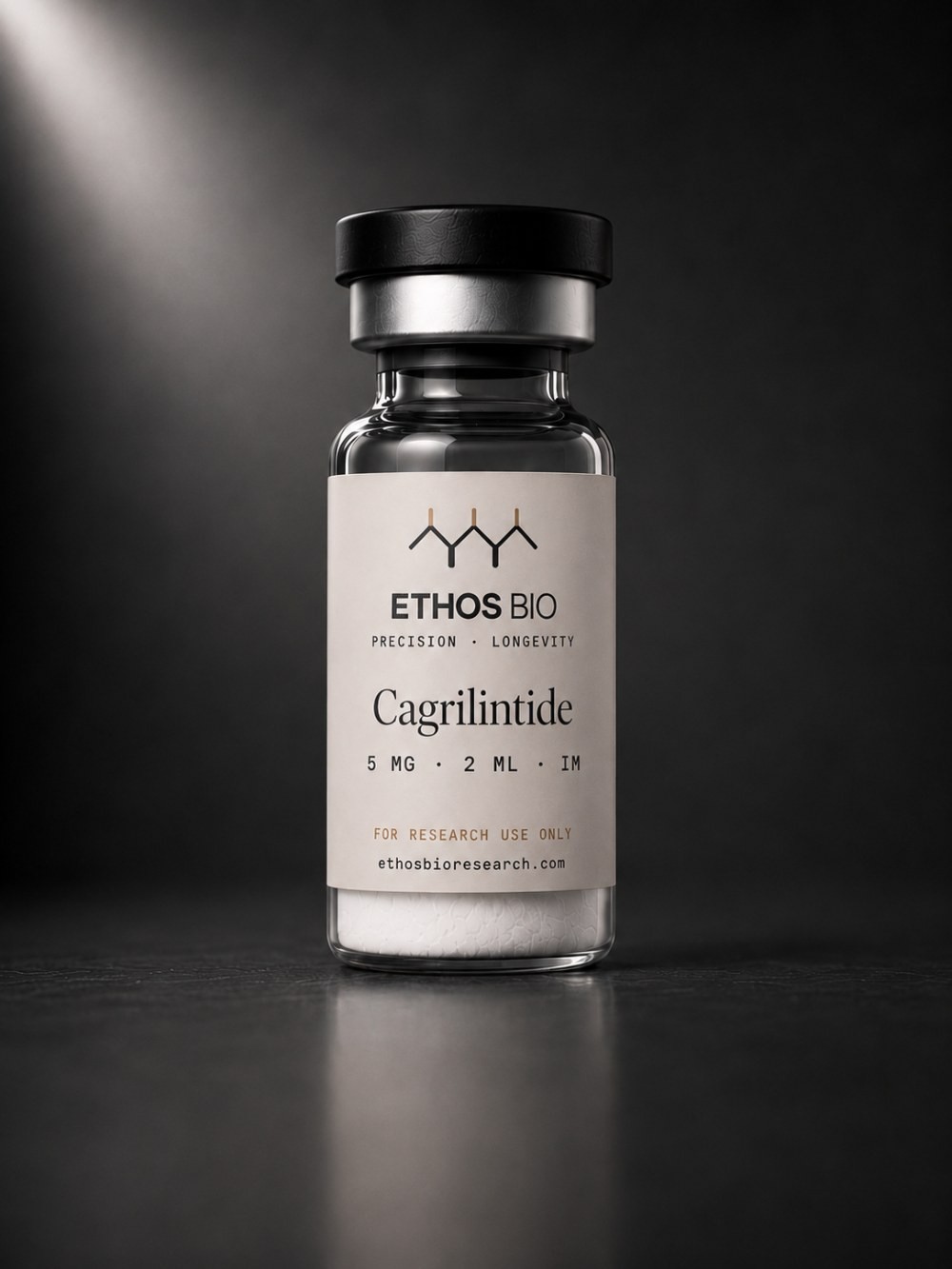
01At a Glance
| Compound | Cagrilintide (AM833) |
| Classification | Metabolic research compound |
| Molecular weight | 3,748.2 g/mol |
| Sequence / Form | Long-acting amylin analog |
| Purity | ≥99% HPLC, identity verified by mass spectrometry |
| Documentation | Batch-specific Certificate of Analysis available |
| Appearance | White lyophilized powder |
| Storage | Store sealed at 2–8°C. Long-term storage per certificate guidance. |
| Use | Research Use Only. Not for human or veterinary use. |
02Mechanism of Action
Cagrilintide is a long-acting synthetic analog of the hormone amylin, studied for agonism at the amylin and calcitonin receptor family. Research models examine its role in satiety signaling, gastric-emptying, and energy-balance pathways.
It is frequently investigated in combination with incretin receptor agonists, where the amylin and incretin pathways are studied together in metabolic research.
Research framing only · No human-use claims
03Research Context
- Amylin / calcitonin receptor agonism assays
- Satiety- and energy-balance signaling models
- Combination amylin + incretin pathway research
- Metabolic-regulation studies
04Quality & Verification
Ethos Bio presents compound information with an emphasis on identity verification, purity analysis, certificate access, and storage guidance. Product-specific documentation is available through the certificate page where applicable. Cold-chain shipping is available where required, and inventory is held under refrigerated conditions at our fulfillment center with temperature-logging protocols in place.
05FAQ
What is Cagrilintide?
Cagrilintide is a long-acting amylin analog studied for amylin-receptor signaling and satiety pathways in research models. It is a research-use-only compound.
What is Cagrilintide studied with?
In research it is frequently paired with incretin receptor agonists to study combined amylin and incretin signaling on metabolism.
What is Cagrilintide\u2019s molecular weight?
Cagrilintide has an approximate molecular weight of 3,748.2 g/mol.
How should Cagrilintide be stored?
Cagrilintide ships lyophilized and should be handled per standard research-peptide practice — kept cold, protected from light and moisture, and reconstituted only for laboratory use. Cold-chain handling is used where required. For research use only.
Is Cagrilintide approved for human use?
No. Cagrilintide is sold strictly for laboratory research use only and is not a drug or supplement. It is not approved for human or veterinary use or consumption.
How is Cagrilintide tested at Ethos Bio?
Every Cagrilintide lot is independently verified by MZ Biolabs, a third-party analytical laboratory in Arizona, on a five-point panel — RP-HPLC purity, HPLC-MS identity, endotoxin (LAL), heavy metals, and sterility. A lot-specific certificate of analysis ships with the vial. See How We Test for the full methodology.