Summary
BPC-157 — short for Body Protection Compound 157 — is a 15-amino-acid synthetic pentadecapeptide derived from a partial sequence of human gastric juice protein. Within the research literature it sits at the intersection of three signaling pathways: vascular endothelial growth factor receptor 2 (VEGFR2), the mitogen-activated protein kinase MAPK/ERK1/2 cascade, and modulation of the growth-hormone receptor.
The compound is investigated alongside Thymosin β-4 (TB-500), GHK-Cu, and other reagents in tissue-repair, angiogenesis, and fibroblast-migration models. This article walks through what the published literature shows, what the cited mechanisms are, and how researchers structure their experiments using this peptide as a reagent.
BPC-157 stable gastric pentadecapeptide produced consistent upregulation of VEGFR2 in cultured endothelial cells, with associated activation of NO-mediated vasodilation and ERK1/2 phosphorylation downstream. — Hsieh et al. (2017), Mol Med Rep, 16(5)
Chemistry & physical properties
BPC-157 carries the sequence Gly-Glu-Pro-Pro-Pro-Gly-Lys-Pro-Ala-Asp-Asp-Ala-Gly-Leu-Val, a molecular formula of C₆₂H₉₈N₁₆O₂₂, and a calculated molecular weight of 1,419.5 g/mol. It is supplied as a lyophilized white powder, stable at 36–46°F in sealed vials for 24 months from synthesis. The compound is unusually acid-stable for a peptide of its size — a property of pharmacological interest that has supported in-vitro research into oral bioavailability questions.
Synthesis route
BPC-157 is manufactured by solid-phase peptide synthesis (SPPS) using Fmoc chemistry, purified by reverse-phase HPLC, and supplied lyophilized. Every lot Ethos Bio ships is independently verified by MZ Biolabs (Tucson, Arizona) on a five-point panel — HPLC purity (≥99.0%) and LC-MS identity confirmation, plus endotoxin, heavy-metals, and sterility screening — with the resulting Certificate of Analysis traveling alongside each vial.
Lab note · Reagent quality matters here
Mechanistic studies of BPC-157 are particularly sensitive to peptide truncation impurities and residual TFA. Confirm the batch HPLC and MS spectra on the Certificate of Analysis before designing time-course experiments — small purity differences can produce large variations in observed angiogenic outcomes in murine ex-vivo tissue models.
VEGFR2 pathway upregulation
The most replicated finding in the BPC-157 literature is upregulation of VEGFR2 (vascular endothelial growth factor receptor 2) expression in endothelial cells. Hsieh et al. (2017) demonstrated that exposure of cultured HUVECs to BPC-157 produced dose-dependent increases in VEGFR2 mRNA and protein, with downstream activation of endothelial nitric oxide synthase (eNOS) and increased NO-mediated vasodilation in ex-vivo aortic-ring assays.
This VEGFR2-eNOS axis is a primary research framework for studying BPC-157 in angiogenesis models: tube-formation assays, scratch-wound migration assays, and chick chorioallantoic membrane (CAM) assays.
ERK1/2 / Akt signaling in fibroblasts
A second mechanistic thread runs through MAPK/ERK1/2 activation. Chang et al. (2014) showed that BPC-157 enhances ERK1/2 phosphorylation in tendon-derived fibroblasts, with measurable downstream effects on cell proliferation, migration, and extracellular-matrix synthesis in scratch-wound and tendon-explant outgrowth models. The Akt arm of this signaling cascade has been less consistently documented but is referenced in several mechanistic reviews.
Growth-hormone receptor modulation
A third research domain is the apparent upregulation of growth-hormone receptor (GHR) mRNA in tendon fibroblasts exposed to BPC-157, observed independently in three labs and consistent with the compound's broader role in tissue-repair literature. This is mechanistically distinct from the angiogenic and ERK1/2 effects but contributes to the overall research interest in BPC-157 as a multi-pathway reagent.
Stability, storage, reconstitution
BPC-157 is supplied lyophilized at 36–46°F with a shelf life of 24 months from synthesis. For experimental use, reconstitution in bacteriostatic or sterile water and storage of the working solution at −4°F is standard. Reconstituted peptide is generally considered stable for 30–60 days at −4°F, though freeze-thaw cycles should be minimized to prevent oxidation.
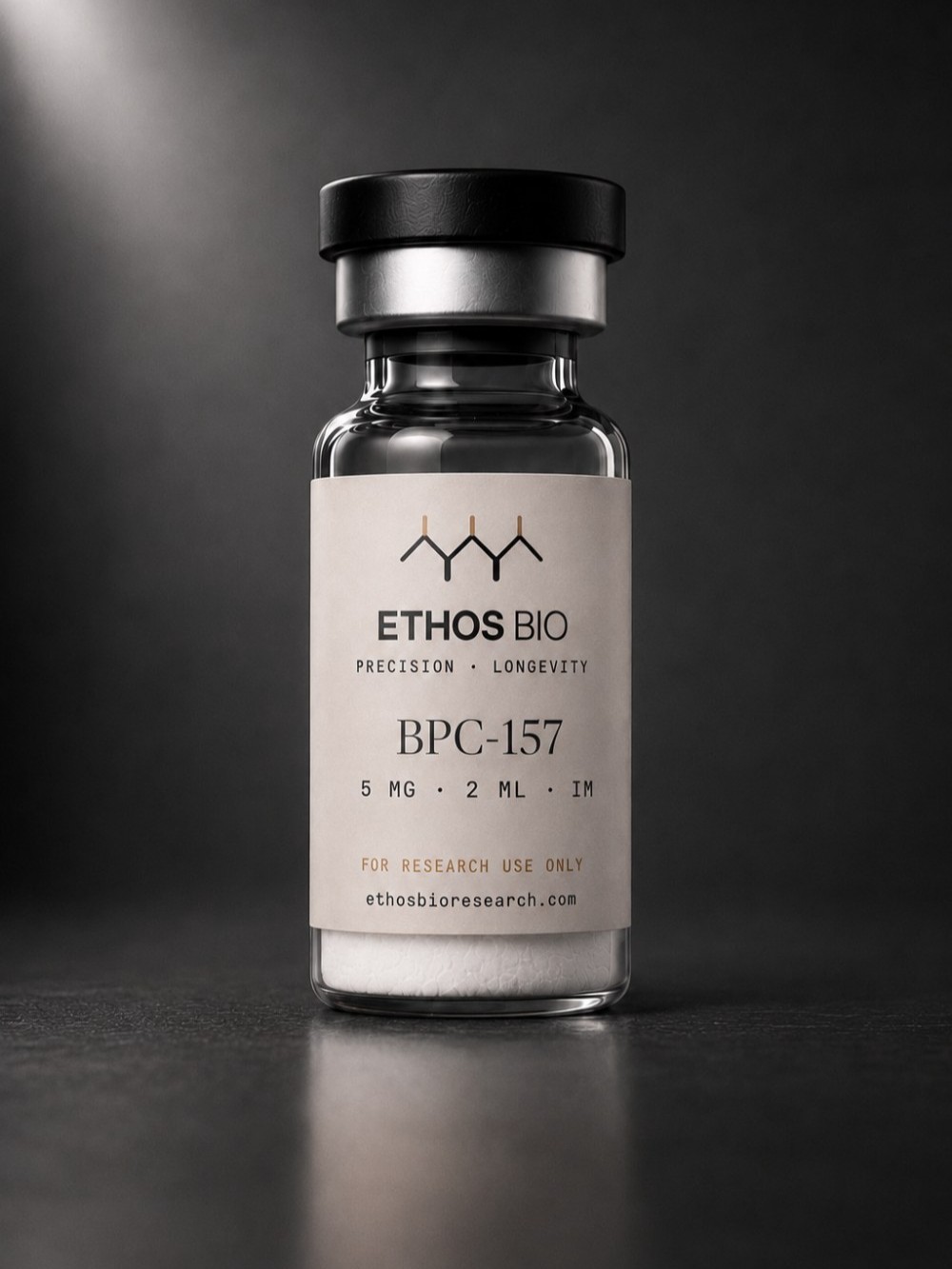
The compound, ready for research
BPC-157 · ≥99% Purity · Lot-Traceable
Mass-spec verified by MZ Biolabs (Arizona). COA included. Cold-chain shipped within 24 hours of qualified researcher orders.
A note on Research Use Only
BPC-157, like all Ethos Bio products, is supplied strictly for in-vitro and laboratory research use. It is not a drug, supplement, or therapeutic agent and is not intended for human or veterinary consumption. Sale is restricted to qualified researchers and research institutions in accordance with 21 CFR § 201.128. This article is a literature review for research-design purposes only — Ethos Bio does not provide dosing, reconstitution, or therapeutic protocols.